
The SN 441011 (SEV 1011) Swiss standard
The Swiss standard is SN 441011, known until recently as SN SEV 1011, and its title is Plugs and socket-outlets for household and similar purposes. Testing and approval is carried out under ESTI, the Federal Inspectorate for Heavy Current Installations, sometimes known as Electrosuisse; approved products are marked S+ or SEV.
For the whole range of Swiss items we sell, please see our product page.
Swiss plugs are only used in Switzerland and Liechtenstein. They are sometimes listed and being used in Rwanda, but based on the local situation this appears to be an online myth. Whilst Brazilian and South African plugs appear very similar, they are not compatible due to the different offset of the earth pin.
Generally, plugs and sockets can be rated at 10A or 16A, and single phase or three phase: sockets will only accept equally or lower rated plugs. Single phase use is rated up to 250V AC, and 3 phase up to 400V AC (Volts, alternating current). Switzerland is unique in have compatibility between single phase and three-phase plug and socket types. Typ 1x are 10A versions, and Typ 2x are 16A rated versions. Plugs and sockets have the central earth pin offset, which ensures polarity: the plug can only be inserted one way round. The earth contacts within the socket are brought forward 3mm, so the protective earth contact is always made first and broken last. The pins on all plugs are 19mm long.
Since 2009 all 10A rated plugs must have 8mm partially insulated line and neutral pins.
This is because older socket outlets were not recessed, and it was possible to partially insert the plug and still touch the now live current carrying contacts, a potentially dangerous situation.
There is no requirement for partial insulation on the 16A versions because the sockets have always been recessed. The shape of the recess prevents dangerous (i.e. unearthed) compatibility with plugs that have similar pins (e.g. French or German plugs) that fit into non-recessed outlets. The recessed socket design also provides structural support to the plug.
There is no requirement for childproof shutters in any of the sockets.
Read on for our full list of Swiss plugs and sockets…
Languages
As Switzerland has four official languages, which also have dialect forms and Helvetisms, plus widespread English takeup, this may mix or even confuse nomenclature. Ignoring the Romansh language (which is not mandated in Federal Acts), the official names for these electrical parts in Swiss German (Schweizerdeutsch, Schwiizerdütsch), Swiss French (français de Suisse, suisse romand) and Swiss Italian (italiano svizzero) respectively are:
| English | German | French | Italian |
| Plug | Stecker | fiche | spina |
| Connector | Kupplung | connecteur | connettore a spina |
| Single phase | Einphasig | monophasé | monofase |
| Multiphase / three-phase | Mehrphasig / dreiphasig | polyphasé / triphasé, | polifase / multiphase |
| Power socket | Steckdose | prise de courant | presa di corrente |
| Extension lead | Verlängerungskabel | prolongateur | cavo di prolunga |
Current types – SN 441011 standard

SN EN 50075 / T26
Essentially the pan-European Europlug, with 4mm tapering pins and rated 2.5A at 250V. It fits all Swiss socket outlets. Sometimes referred to as Typ 26, which does not fit the naming convention, but is the next available number sequentially..
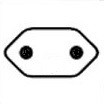
T11
The Typ 11 plug is a 10A rated ungrounded plug with straight 4mm diameter pins spaced at 19mm. There is no wall outlet, but a trailing sockets for extension leads exist, which have a collar to make the socket recessed. Unearthed 2 pole plugs and sockets cannot be supplied as rewireables. The plug fits all sockets, and the socket accepts T11 and Euoplugs. It was first standardised in 1952, and the current version is SEV 6533-1:2009 for the socket and 6533-2 for the plug.

T12
The SN 441011 Typ 12 plug (SEV 1011 Typ 12) is the main plug used in Switzerland. It is the same layout as the T11, but adds a third central earth pin offset by 5mm. In the IEC categorisation it is known as type J plug. Type 12 sockets were flush, not recessed, and since 2012 are longer permitted for sale or import: they have been replaced by the T13. The T12 plug fits all earthed outlets, and was first codified in 1937 in SEV 6534-2 (6534-1 for the deprecated socket).

T13
The T13 socket is a revision (SEV 6535:2009) of the T12 socket, but recessed to prevent accidental shock with uninsulated plug pins. Even when the T12 was still current, T13 sockets were required in humid conditions including bathrooms, and also in places of work. This is the normal Swiss domestic power outlet, also known as type J socket. It accepts T12, T11 and Europlugs. Sockets may have three outlets in a circle, with the earth aperture innermost.

T15
The T15 plug and socket are a 10A 250V / 400V 3 phase system introduced in 1979 to replace previous 2- and 3-phase systems. The layout is the same as the single phase T12/T13, but adds an extra two flat pins for the two additional phases, making 5 in total: 3 Pole plus Neutral plus Earth. The Swiss 3 phase plug SEV 6532-2 fits 3 phase outlets (T15 & T25), and the recessed 6532-1 socket accepts T15, T12, T11 and Europlugs.

T21
The Typ 21 plug is a 2 pole unearthed 16A plug with larger rectangular 4mm x 5mm pins, which are uninsulated. Like the T11 10A version, there is no wall socket, only an inline cable connector for extension leads, and rewireables are not permitted. The SEV 5933-1 plug fits 16A outlets (T21, T23, T25), and the 5933-2 inline socket accept ungrounded plugs (T21, T11, Europlug).

T23
The Typ 23 plugs and sockets are an earthed version of the T21, adding an offset grounding pin. The SEV 5934-1 socket accepts all single phase plugs (T21, T12, T11, Europlug), and the SEV 5934-2 plug fits 16A sockets (T23, T25).

T25
The Typ 25 is a three phase version of T23, adding two more slightly smaller pins. It is 3P+N+E rated 16A 250V / 400V, and like all the 16a plugs was introduced in 1998. The SEV 5932-2 T25 plug only fits the 5932-1 matching socket, but the recessed socket outlet accepts all Swiss plugs.
Typ-adaptors
In addition to the standard plugs, SN SEV 1011:2009/A1:2012 appendix A1 Multiway and intermediate adapters, cord sets, cord extension sets, travel adaptors and fixed adaptors sets out requirements for various adaptors for using e.g. neighbouring French, German and Italian standard plugs in Switzerland. Usage is limited to 1 hour at maximum load, adaptors cannot be stacked, i.e. multiple adaptors used simultaneously, and their design must prevent a single pin from being inserted on its own. Multiway adaptors are limited to a maximum of four outlets, and multiple socket extension leads now require a thermal circuit breaker for added overcurrent protection. This is because 10A plugs fit a 16A socket, which is protected by a 16A circuit breaker: with an extension lead it is possible for several appliance to draw in excess of the plug’s 10A rating before tripping the breaker. All products must conform to the Verordnung über elektrische Niederspannungserzeugnisse, NEV, or low voltage equipment ordinance.
Obsolete types – SEV 1011 standard

T1
The Typ 1 was a rectangular 10A 2 pole plug and socket, now replaced by T11. The sockets are long obsolete, but the plugs could be purchased domestically until the year 2000.

T2
The Typ 2 plug and socket was an early grounded Swiss plug, using a reverse earth pin similar the French CEE7/5. Rated 10A 250V, it has been replaced by T12 and T13.

T7
Typ 7 was a 500V 15A 2-phase and earth (2P+E) system for electric cookers. It had a similar pin configuration to contemporary Swiss plugs, but a larger earth pin and wider spacing. It was replaced by the 3 phase T25.

T8
The Typ 8 was a 3 phase electric oven plug and socket (3P+E) rated 500V 15A, also replaced by the T25.

T9
The Typ 9 was a 3 phase (3P+N+E) 500V 25A plug and outlet, again for electric cookers. The pin layout is similar to T25.

T10
The Typ 10 was another 3 phase (3P+E) 500V 25A plug, with 4 pins arranged in a square.

T14
The Typ 14 was a transition socket that complied with both T2 (reverse earth pin) and the modern T13 requirements. Not permitted since 1974.

T18
The Typ 18 was a single phase 10A 380V plug and socket with perpendicular flat blade line and neutral pins; the earth is a round reverse pin in the socket, pictured, like the T2.

T19
The Typ 19 is a later development and identical to the T18, except its earth is a round aperture in the socket instead.

T20
The Typ 20 socket was designed to accept both T18 and T19 plugs, so has both the earthing pin and the earthing aperture. The T18, T19 and T20 were phased out in the 1980s in favour of the 3 phase system.

J-plugs
Another obsolete series of plug is the J plugs, industrial grade plugs and sockets now replaced by IEC 60309. These were rectangular plugs with flat parallel pins in line. These are SEV Types 30, 34, 52, 53, 56, 57, 60 and 61; full details of pin configurations and voltage and current ratings are available upon request. Some replacement IEC 60309 parts also have Swiss standard numbers: a 2P+E 230V 16A is SEV Typ 63 for example.
Need help finding the right product?
Whether you need a specific international plug, socket, cable or technical advice, our team can help.