
South African SANS 164 standard
They are still used in many Commonwealth nations: generally central and southern Africa, India and surrounding nations, some parts of the Middle East and Asia.
SANS 164-1 and SANS164-3 are compatible with UK BS546 and Indian IS1293, although there are differences. BS546 requires sockets to be shuttered (older SANS sockets are not), and UK and India require the rewireable plug to show the earth terminal has been connected (usually a small inspection hole on the top of the plug directly above the earth pin). BS546 plugs must have partially insulated line and neutral pins, and may have an optional BS646 fuse.
The overall standard is not enshrined in national legislation, but instead as a regulation within a mandatory South African National Standard, “Plug and socket-outlet systems for household and similar purposes for use in South Africa”, which has several sub-categories as listed below. All are rated up to 250V AC, and all are polarised by design except the Europlug-derived -6 variant. Approval in South Africa in normally by SABS, the South African Bureau of Standards, but inspection can be by other bodies.
The plugs and sockets of different current ratings are different sizes, so are not interchangeable. Power outlets may have more than one type of socket, e.g. 6A and 16A superimposed on each other, or new type and old type next to each other. Whilst not a requirement, most South African sockets have on/off switches.
SANS 164 standard

SANS 164-1
The normal or old type South African plug, which is by far the most commonly used. Based on the 15 Amp UK BS546, but up-rated to 16 Amp in line with domestic circuit breakers when it became the South African standard. It has three round pins: line and neutral 7mm diameter and the longer earth pin 8.7mm diameter. The pins do not always have partial insulation, so there is an electrocution risk if the plug is only part way inserted and the switch is on. It is planned to be slowly phased out in favour of the new -2 system below. This is plug type M in the IEC classification system.
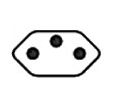
SANS 164-2
The new South African plug. Based on the IEC 60906-1 system originally designed to replace all plugs in the world, it has only been adopted in South Africa. Also rated 16 Amp, it is available in 3 pin earthed and lower-rated 2 pin unearthed versions. Hexagonal in shape with 4.5mm diameter pins, it closely resembles Swiss and Brazilian plugs, but these are not interchangeable as the earth is offset by 3mm; sockets do however accept CEE7/16 Europlugs which are often found on small electronics e.g. phone chargers.
In contrast to SANS 164-1, to prevent accidental contact with current-carrying parts, the plugs have part insulation on the live and neutral pins, and sockets are recessed. There is also a second order safety aspect: the sockets are smaller, so more fit on the same size wall plate, reducing or eliminating the need for dangerous multi-socket adaptors.
It is much smaller than its predecessor, saving raw materials in manufacture then space in both transit and the end application, which will decrease costs as demand increases.
The new ZA plug entered the SANS standard in 1992, and from 2015 is to become the preferred type; all new applications must have at least one SANS 164-2 power outlet. This transition from old to new is planned to be organic and estimated to take ten to twenty years. This is the N type plug in the IEC classification system.

SANS 164-2-1
A ‘partially dedicated’ South African plug, designed to replace the -4 described below, and introduced in 2018. One side of the plug has been removed, and there is a cutout at the bottom. This means partially-dedicated plugs will fit both normal 164-2 and partially dedicated 164-2-1 sockets, but the 164-2-1 outlet will only accept the matching plug. The colour coding is the same as 164-4 below, and the position of the cutout changes with the colour.
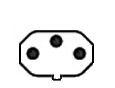
SANS 164-2-2
A ‘fully dedicated’ South African plug. Both sides have been removed from the plug, and the cutout replaced with a protrusion; this means only dedicated plugs and sockets will mate. Colour coding and location of the protrusion also vary by usage.

SANS 164-3
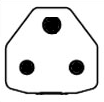
Based on the BS546 5A plug, but re-rated to 6A instead. It looks like a scaled-down version of SANS 164-1, with 5.1mm diameter line and neutral pins and 7mm earth pin.
Whilst added to the standard in 2006, it had fallen out of usage much earlier by 1992 when all South African plugs were codified into one national document. Previous to this the BS546 5 Amp was used, but had been increasingly replaced by the BS546 15A (which became SANS 164-1). Outlets may still be found in older buildings, and moulded mains leads exist, but rewireable plugs are very rare. This is the main plug type used in some other Southern African countries, as well as India, and is plug type D in the IEC system.
SANS 164-4
These are dedicated South African plugs and sockets for special local power applications, added to the standard in 2006. They are only used in South Africa, and no other countries that use this type plug.
A standard -1 plug is modified so the earth pin is flattened: this means it will fit into both dedicated and non-dedicated sockets, but the dedicated socket will only accept dedicated plugs.
The most common dedicated system has the flat section on the earth at the top, which is used for ‘special power’ e.g. computer systems where separate power and ‘clean’ earth are required; plug and socket are red in colour. The flat section on the socket is rotated 53 degrees clockwise is used for uninterruptible power supplies (UPS) and are blue. Black sockets are rotated 53 degrees anticlockwise and are used for transformer-specific power.

SANS 164-5
These are identical to the CEE7/16 Europlug which is often found on imported electrical equipment and consumer electronics, and also rated 2.5A. These are not permitted as a rewireable plug, so must be moulded only, and there is no specified matching socket as the plugs fit the new style power outlets. These were also added to the standard in 2006.

SANS 164-6
Identical to the European CEE7/17 Contour plug, these are also unearthed and rated 16A. These will fit into matching sockets, along with French and German type sockets. Schuko plugs have been specifically prohibited in South Africa on safety grounds, but the -6 was added in 2006 due to the large number of European power tools imported with this type plug. Travel adaptor type convertors to fit -1 sockets are common.
Head Office
Morvan Trading Ltd,
Westover Farm,
Goodworth Clatford,
Andover, Hampshire,
SP11 7LF