
4 rare, obscure and interesting
AC power connectors
Need help to identify plugs? This page provides rare, obscure and interesting AC electrical plug connectors from around the world: IEC C9, HNA plug, Electrak plug, DIN 49491 conector.
For more product, standards and compliance insights, browse our technical articles.

IEC C9
The IEC C9 is listed under IEC 60320, and is rated 6A at 250V and 70°C; it is class II, so ungrounded. The corresponding appliance inlet is the C10. Historically a polarised version, the C11 connector and C12 inlet, also existed, but this has been withdrawn from the IEC standard. Being unearthed, the IEC C9 is not permitted for sale as a rewireable connector; once wired onto cable it cannot be disassembled in order to protect the end user.
It was largely phased out in the 1980s in favour of more standard IEC connectors, either C7 for up to 2.5A current draw, or C13 / C17 for up to 10A. The C9 IEC is mostly used on audio equipment, including synthesisers, reel-to-reel tape machines, hifis, turntables etc. High quality vintage sound equipment is long-lasting so the connector is still in demand. Another reasonably common use is in sewing machines and knitting machines. Manufacturers known to have used the IEC C9 are Akai, Marantz, Revox, Roland, Singer, Tandberg, and Telefunken.
We offer the C9 both as a loose wireable connector (see the first item on rewireable IEC page), and assembled onto a variety of international mains cables, where the most common is a UK plug to IEC C9 on 2 metres of cable. For hifi use we can also supply on larger cross-section and shielded cable for cleaner sound.
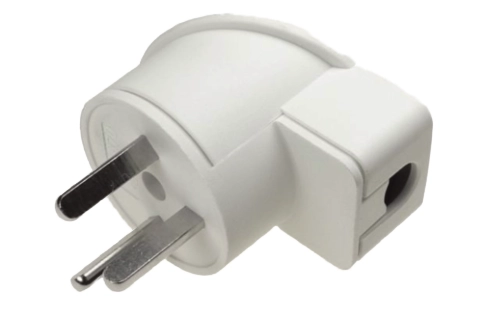
HNA plug
The HNA plug was specified by the HNA (Handelsschiff Normen Ausschuss or Merchant Shipping Standards Committee) in the 1920s-30s; the committee later became part of the DIN (Deutsches Institüt für Normung).
The original HNA specification is rated 10A 250V with round pins, and has an IP56 waterproof design with cover for maritime use, similar to the contemporaneous Niphan marine plugs and sockets, or the modern IEC60309 system. The original sockets accept both round pin and flat pin types.
A later version for domestic use has flat pins (4.8 x 2.5mm) which is the type we supply as a rewireable plug, only currently in colour white. Unlike the original, it isn’t waterproof, and flat pins are a safety requirement to prevent the use of unearthed round pin plugs in the corresponding socket. Alternatively we can supply them assembled on cable, usually as an HNA plug to C13 IEC. The HNA plug is usually used on specific applications, for example data circuits.

DIN 49491
The DIN 49491 connectors (originally DIN 4990 from 1920, then DIN 4991) were predecessors of the current IEC 60320 range, used in a variety of domestic appliances from the 1920s to the 1960s. The German names Waffeleisenstecker (waffle iron plug), Bügeleisenstecker (electric iron plug), and Heißgerätekabel (hot equipment cable) give an idea of the typical uses, which also included kettles, electric urns and slide projectors. DIN49491 connectors are rated 16A at 250V AC, and temperature 155°C.
Comparing DIN49491 to IEC 60320 shows a few safety improvements that have been made. Not all connectors are earthed, but the appliance inlet accepts both earthed and unearthed versions; the earth is the steel clip on the face of the connector. As the two are 100% interchangeable, we only stock the earthed type for safety. The insulator is made from porcelain, and the main body from Bakelite: this could conduct heat from the device to the connector body and a potential burn risk to the user when unplugging the connector. The apertures for the line and neutral are large enough to pose a shock hazard from small metal objects or children’s fingers. Porcelain and Bakelite are also both brittle materials and prone to breaking when dropped.
For these reasons DIN 49491 is no longer on the open market as electrical connectors. Current industrial specialist applications include powering injection moulding machines and extruders, heated thermoset moulds and solder baths etc. We hold a handful in stock for these specialised uses, and also for the repair and refurbishment of older (and even antique) electrical equipment.

Electrak key plug
The Electrak key plug has three brass pins mounted on a barrel that fits inside the socket, which is inserted and then turned 90 degrees like a key, hence the name. The Electrak design is patented, and the brand has been owned by Legrand S.A. since 2008.
The Electrak key socket is unswitched, but has a safety shutter to prevent access when no plug is engaged; it is depressed when the plug is inserted. The 90 degree locking mechanism stops unauthorised or accidental removal, and the non-standard design prevents use of normal mains plugs (although an adaptor does exist). There are three different types manufactured by Electrak:
- Standard / clean earth plug. Colour white, and often used in dedicated ‘clean’ earth applications, for example sensitive electronic equipment including computers where interference and noise may transmitted back up through the normal earth wiring.
- EPOS plug (Electronic Point of Sale). Both plugs and sockets are red in colour with ‘EPOS’ marked on them. These are used in retail point-of-sale environments, for example tills and cash registers, scales, barcode scanners, credit/debit card terminals..
- UPS plug (Uninterruptible Power Supply). Coloured blue and marked UPS, these prevent accidental unplugging and ensure only permitted appliances are connected.
The three versions have a plastic leader in front of different pins, which makes the three types not interchangeable. The Electrak plug is rated at 240V 13A, and accepts up to 3 core 1.5mm cable. It is fitted with a standard BS1362 fuse as found in normal UK plugs; this is normally 13A, but can be changed to a lower rated fuse as required by the cable fitted. All meet the BS5733 standard.
Mystery plugs?
We are more than happy to help with any technical query whatsoever relating to these 4 types listed, or any other rare plugs. We enjoy a challenge, identifying and sourcing the old, rare, propietary, obsolete, discontinued and obscure. For mystery plugs and connectors, please email a photo plus any context, e.g. approximate age, originating country, application, and any other relevant information. If all else fails, we can recommend the most appropriate modern replacement based on its specifications and environment, e.g. current, voltage, temperature, water resistance etc.
Head Office
Morvan Trading Ltd,
Westover Farm,
Goodworth Clatford,
Andover, Hampshire,
SP11 7LF